
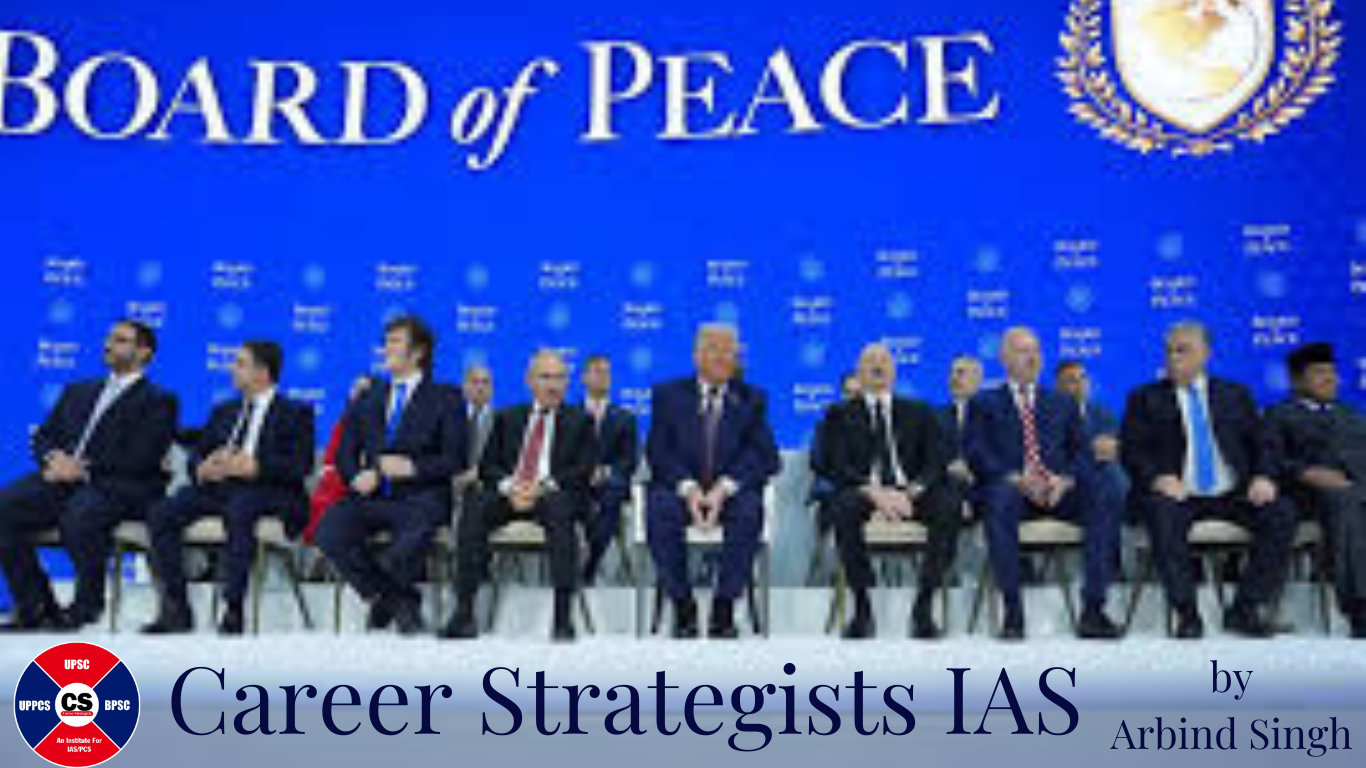
‘Board of Peace’
Definition and Origin:
The Board of Peace (BoP) is a newly established international organisation proposed by U.S. President Donald Trump, launched formally at the World Economic Forum in Davos in January 2026. Its charter was signed on the sidelines of WEF, marking the first official meeting of this body.
Objectives:
- Initially conceived as part of Trump’s 20-point Gaza peace plan, the BoP’s official purpose is to:
- Promote peace and stability in conflict-affected regions,
- Oversee reconstruction, governance, and security,
- Facilitate diplomatic efforts and long-term conflict management.
Structure:
- Chairman: Donald Trump — with no fixed term limit.
- Founding Members: Leaders from ~20–25 invited nations have signed the charter; up to 50–60 countries have been invited.
- Countries may contribute US$1 billion for permanent membership; others can serve three-year terms without payment.
Not a Traditional Treaty Body:
Official records indicate it is not currently established by multilateral treaty — it is an international organisation formed by invitation and operates under its own charter. Its administrative location is reported as Washington, D.C.
This is the most significant geopolitical question surrounding the Board of Peace.
Claimed Relationship with the UN:
Trump and U.S. officials assert the BoP could “work with … including the United Nations” and support peace-building objectives.
Reality and Concern:
- Not a UN body: It was not created through the UN system and has no formal UN mandate or legal status within established multilateral frameworks such as the UN Charter.
- Overlap with UN Roles: The BoP’s broad scope — from peace implementation to governance and reconstruction — parallels functions traditionally exercised by the UN Security Council and its agencies, raising concerns of institutional overlap.
- Criticism by Europe: The European Union has expressed concerns that the board’s centralised structure, with Trump as lifelong chair, could undermine multilateral norms and EU legal principles.
Thus, while not formally a UN parallel, the BoP’s structure, leadership model, and ambitions have led critics to describe it as an alternative or competitor to multilateral mechanisms.
Current Position:
India abstained from signing the charter at the Davos ceremony, and New Delhi has not formally decided whether to join.
Reasons for Caution:
- India reportedly wants clarity on the Board’s longevity and institutional safeguards — including what happens once Trump leaves office.
- New Delhi emphasises its longstanding commitment to UN-centric multilateralism and is wary of endorsing structures that might dilute established norms.
- The government is also conscious of the optics of joining a U.S.-led initiative with fewer Western allies and controversial governance mechanisms.
Strategic Assessment:
Experts have suggested India should keep engagement options open while ensuring participation does not weaken global institutions it relies on, like the UN.

Pros
Diplomatic Influence:
- Participation could give India a seat at a new power centre shaping post-conflict governance models, particularly related to West Asia.
- Involvement may allow India to shape outcomes rather than be outside a forum that may grow in stature.
Economic and Strategic Engagement:
- The Board aims to mobilise funds (reported target of ~US$50+ billion) for reconstruction and development — a potential avenue for Indian investment and influence.
- Alignment with major regional developments in West Asia and Central Asia could support India’s Connect Central Asia and Middle East strategies.
Realpolitik Gains:
- Engaging with the U.S. and board members may improve bilateral cooperation on broader security and economic issues.
Cons
Undermining Multilateralism:
- The Board is perceived as US-centric, with leadership concentrated in one individual, contrasting with egalitarian decision-making in bodies like the UN.
- India risks signaling a shift away from its UN-based global governance preference.
Uncertain Institutional Legitimacy:
- Lack of a robust charter, succession mechanisms, or global accountability frameworks raises questions about long-term relevance and credibility.
Financial and Political Costs:
- The reported US$1 billion fee for permanent membership could be seen as controversial or burdensome.
- Joining could put India in a political bind if the board’s actions conflict with India’s positions on Palestine, Russia, or other critical global issues.
a. Multilateralism vs. Minilateralism
The board’s emergence highlights a tension between traditional multilateral frameworks (UN, WTO) and new minilateral or specialised groupings shaped by powerful states. The BoP could accelerate this trend, leading to:
- Fragmentation of global governance norms,
- A shift from consensus-driven diplomacy to leader-centric initiatives,
- Potential duplication of peace and reconstruction mandates.
India, advocating for UN reforms, may find itself balancing participation in new frameworks while defending existing systems.
b. Geopolitical Alignments
The BoP’s membership includes countries from the Middle East, South Asia, Latin America, and Central Asia, with Western European participation limited. This could result in:
- New regional groupings outside OECD frameworks,
- Increased influence of non-Western diplomacy in conflict resolution,
- A possible US-led alternative to European or UN-centred peace architectures.

Comparative Table: Board of Peace (BoP) vs United Nations (UN)
| Dimension | Board of Peace (BoP) | United Nations (UN) |
|---|---|---|
| Year of Origin | 2026 | 1945 |
| Founding Context | Created amid dissatisfaction with existing conflict-resolution mechanisms, especially Gaza conflict | Established after World War II to prevent future global conflicts |
| Founder / Driving Force | Initiated by U.S. President Donald Trump | Founded collectively by 51 countries |
| Nature | US-led, invitation-based international body | Universal, multilateral organisation |
| Legal Basis | Charter signed at Davos; not treaty-based | UN Charter (international treaty) |
| Membership | Selective; invitation-only | Near-universal (193 member states) |
| Leadership Structure | Centralised; Trump as permanent chair | Rotational leadership; Secretary-General elected |
| Decision-Making | Leader-centric, informal consensus | Institutionalised voting & veto systems |
| Primary Objective | Conflict management, post-war governance, reconstruction | International peace, security, development, human rights |
| Key Organs | Board/Executive council (structure evolving) | UNSC, UNGA, ECOSOC, ICJ, Secretariat |
| Peace Enforcement | Ad-hoc mechanisms, political leverage | UN Peacekeeping Operations with mandates |
| Funding Model | Voluntary contributions; permanent membership fee reported | Assessed and voluntary contributions |
| Scope of Authority | Limited, issue-specific (initially Gaza-centric) | Broad global mandate |
| Institutional Permanence | Uncertain; leadership-dependent | Permanent global institution |
| Accountability Mechanisms | Weak or evolving | Established legal and reporting mechanisms |
| Relation with International Law | Ambiguous; operates outside UN legal framework | Central pillar of international law |
| Global Acceptance | Mixed; skepticism among EU and some democracies | Widely accepted and recognised |
| India’s Position | Cautious; not joined yet | Founding member; strong supporter |
| Criticism | Seen as parallel to UN, US-centric, legitimacy concerns | Slow decision-making, veto deadlock |
| Relevance for India | Strategic engagement opportunity but risky | Core platform for diplomacy and peacekeeping |
Conclusion
The Board of Peace is a significant geopolitical innovation — not merely another diplomatic forum but potentially a new node in the evolving architecture of global governance. Its launch reflects:
- Persistent dissatisfaction with traditional conflict resolution mechanisms,
- A shift toward powerful state-driven, leader-centric models, and
- Strategic competition over who sets the rules in international peace and security efforts.
For UPSC aspirants, key takeaways are:
- Understanding how emerging institutions interact with established ones like the UN,
- Analysing India’s strategic calculus in global governance platforms,
- Recognising the broader implications for multilateralism, sovereignty, and international law.

